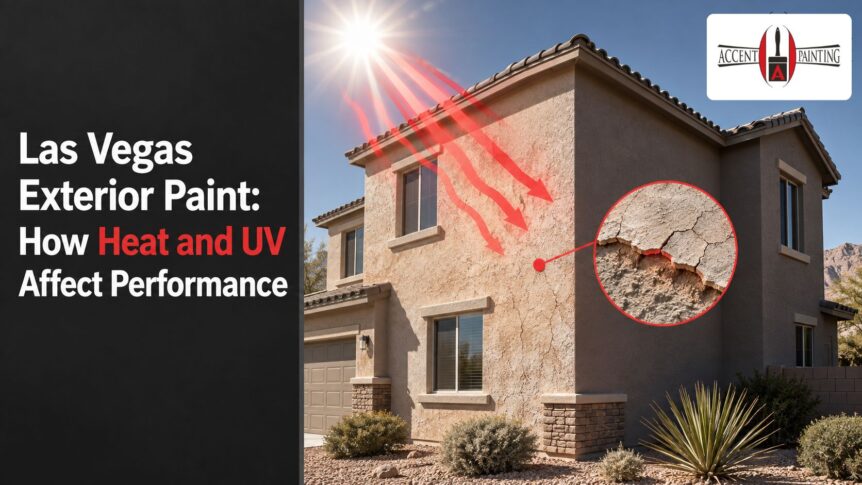
Las Vegas exterior paint faces faster fading, chalking, cracking, and adhesion loss because intense sunlight breaks down the coating while hot surfaces repeatedly expand and contract. The damage is usually most noticeable on south- and west-facing walls, trim, doors, and other areas receiving prolonged afternoon sun.
The right coating matters, but paint quality alone cannot overcome poor preparation or application on an overheated surface. A durable result requires the correct combination of surface repairs, primer, coating system, weather conditions, and application method.
What heat and UV exposure do to exterior paint
Paint is more than color. Once cured, it forms a protective film made from binders, pigments, and additives. Desert sunlight and heat gradually affect each part of that film.
UV radiation breaks down the coating.
Ultraviolet radiation can weaken the paint’s binder and alter certain pigments. As the coating deteriorates, the surface may lose color, become brittle, or develop a powdery residue.
Common signs of UV damage to exterior paint include:
- Uneven fading between sunny and shaded walls
- A dull or washed-out appearance
- White or colored powder that transfers to your hand
- Small surface cracks
- Loss of flexibility around joints and trim
This process does not happen evenly. A protected north-facing wall may still look acceptable while a west-facing wall has already faded noticeably.
High surface temperatures affect paint performance.
The temperature of a wall can be considerably higher than the surrounding air when it is exposed to direct sunlight. Dark colors, metal surfaces, garage doors, and west-facing elevations may absorb even more heat.
If paint is applied to a surface that is hotter than the product allows, it may dry before it can flow and form a uniform film. This can contribute to lap marks, visible brush lines, poor leveling, and reduced adhesion.
Temperature changes create movement.
Exterior materials expand as they heat and contract as they cool. The movement may be small, but it happens repeatedly.
Stucco, wood, metal, sealants, and paint do not all move at the same rate. Over time, this difference can open hairline cracks or weaken paint around joints and material transitions.
In short: Sunlight damages the coating chemically, while heat stresses it physically. The two conditions often work together.
Why some parts of a Las Vegas property fail first
Exposure matters as much as the paint itself. Two walls on the same building can age at very different rates.
South-facing walls receive substantial sun exposure throughout the day. West-facing walls take the stronger afternoon heat, when outdoor temperatures are often already elevated. Walls protected by patios, trees, or adjacent buildings may deteriorate more slowly.
Other conditions can accelerate exterior paint fading or failure:
- Irrigation repeatedly spraying walls
- Cracks allowing moisture behind the coating
- Dust left on the surface before painting
- Missing or incorrect primer
- Painting over loose or chalky material
- Thin or uneven paint coverage
- Incompatible old and new coatings
- Rust beneath paint on metal surfaces
- Failed caulk around doors, windows, and joints
Heat and UV exposure are not responsible for every paint problem. Peeling near the bottom of a wall, for example, may be related to irrigation or moisture rather than sunlight alone.
Warning signs your exterior paint needs attention.
Fading does not always mean the coating has stopped protecting the building. Peeling, exposed material, open cracks, and widespread adhesion loss are more urgent.
What you see | Likely issue | Recommended response |
Faded color on sunny walls | UV exposure and pigment breakdown | Inspect the remaining coating before deciding whether to repaint |
Powder on the surface | Exterior paint chalking | Clean and test the surface before applying new paint |
Hairline stucco cracks | Thermal movement or normal stucco movement | Repair suitable cracks before repainting |
Peeling or flaking | Moisture, contamination, or paint adhesion failure | Remove failed material and identify the underlying cause |
Bubbles or blisters | Trapped moisture or application on a hot surface | Investigate moisture and coating conditions |
Rust showing through metal paint | Failed coating or unsuitable primer | Remove rust and use a compatible metal primer |
Cracked caulk around openings | Heat, age, and joint movement | Remove failed caulk and reseal the joint |
A simple chalk check can be useful. Rub a clean, dark cloth across a dry painted wall. Heavy powder transfer suggests the coating needs more than a quick touch-up.
Do not paint directly over heavy chalking. New paint may bond to the loose powder instead of the stable surface beneath it.
How different exterior surfaces respond
Las Vegas properties often combine stucco, wood trim, metal, masonry, and previously coated doors or windows. Each material requires a different approach.
Stucco and masonry
Stucco can develop hairline cracks, impact damage, and areas of powdery paint. Before Las Vegas stucco painting, the surface should be cleaned and allowed to dry, while cracks and failed patches should be repaired with compatible materials.
Fresh or repaired masonry may also require a primer suited to alkaline surfaces. Painting before repairs have cured can create discoloration or adhesion problems.
Wood trim and fascia
Wood expands and contracts as temperature and moisture conditions change. Split wood, open joints, peeling edges, and exposed end grain should be corrected before painting.
Bare wood may require a stain-blocking or bonding primer. Applying finish paint over weathered fibers will not restore a stable surface.
Metal doors, railings, and equipment
Metal can become extremely hot in direct sunlight. Rust, oxidation, and loose coatings must be removed before applying a primer designed for the specific metal.
Painting warm metal without checking its surface temperature can produce visible defects or premature coating failure.
What exterior paint works in the Las Vegas climate?
There is no universal product that performs properly on every surface. The coating must match the substrate, existing finish, exposure, and condition of the building.
A premium 100% acrylic exterior paint is commonly appropriate for residential stucco, masonry, siding, and trim because it offers good flexibility, adhesion, and resistance to sunlight. However, the product label and technical data sheet must confirm that it is approved for the actual surface.
When comparing coatings, consider:
- Compatibility with stucco, masonry, wood, or metal
- UV and color-fade resistance
- Recommended primer
- Acceptable surface-temperature range
- Required number of coats
- Recommended coverage rate
- Cure time and recoat time
- Resistance to chalking and dirt pickup
- Manufacturer requirements for existing coatings
The term heat-resistant exterior paint can be misleading. A product intended for hot industrial equipment is not automatically suitable for house stucco, and a reflective roof coating should not be substituted for wall paint without manufacturer approval.
Does paint color affect durability?
Color can influence surface temperature and visible fading. Darker colors generally absorb more solar heat, while highly saturated colors may show pigment changes more clearly.
That does not mean every light color will outperform every dark one. Pigment quality, resin quality, wall orientation, preparation, and film thickness all affect the result.
Is elastomeric paint always better for stucco?
No. Elastomeric coatings can bridge certain minor cracks and create a thicker film, but they are not automatically the right choice for every stucco wall.
If moisture is entering from behind the wall, a thick coating may conceal rather than solve the problem. The wall condition and moisture source should be evaluated before selecting an elastomeric system.
In short: Choose paint by surface and exposure, not by a single marketing claim.
Surface preparation determines whether the paint can bond
Even an expensive coating can fail if it is applied over dust, loose paint, heavy chalk, rust, moisture, or unstable repairs.
Proper exterior surface preparation may include:
- Inspecting each elevation separately
- Cleaning dirt, dust, and loose chalk
- Removing peeling or poorly bonded paint
- Repairing stucco, plaster, or damaged wood
- Addressing irrigation or moisture problems
- Sanding glossy surfaces where required
- Priming bare, patched, stained, or difficult areas
- Replacing failed sealant around joints
- Applying the specified number of finish coats
Pressure washing is not automatically the right answer. Excessive pressure can damage stucco, force water into cracks, or create new repair work. Cleaning pressure and technique should match the surface.
Paint should also be applied only after washed or repaired areas are adequately dry.
Can exterior painting be done during a Las Vegas summer?
Yes, but exterior house painting in Las Vegas must be scheduled around actual surface conditions. Checking the weather forecast alone is not enough.
Professional crews may work on shaded elevations, begin earlier in the day, move around the building as sun exposure changes, and use an infrared thermometer to check surface temperature. Painting should stop when conditions fall outside the coating manufacturer’s stated limits.
The crew should consider:
- Air and surface temperature
- Direct sunlight
- Wind and blowing dust
- Overnight temperature
- Recoat and cure time
- The amount of shade on each elevation
Adding water or another thinner to make paint easier to use in the heat is not a valid shortcut unless the manufacturer specifically permits it. Excessive thinning can reduce film thickness and alter performance.
In short: Summer painting is possible, but the work must follow the product’s surface-temperature and application requirements.
How often should exterior paint be inspected or replaced?
There is no honest universal answer to how often you should repaint a house in Las Vegas. Repaint timing depends on the coating system, surface preparation, color, wall orientation, material, irrigation exposure, and maintenance.
Inspect the exterior at least once a year and after major repair work. Pay particular attention to west-facing walls, fascia, doors, exposed wood, parapets, perimeter walls, and areas near sprinklers.
Consider repainting when you find:
- Widespread or severe fading
- Heavy chalking that cleaning cannot resolve
- Peeling across multiple areas
- Exposed stucco, wood, or metal
- Numerous cracked or failed joints
- Coating that no longer bonds to the surface
- Repeated touch-ups that no longer blend or hold
Minor fading may be cosmetic. Exposed wood, rusting metal, open joints, or expanding areas of peeling require faster action.
Practical exterior paint maintenance
Regular exterior paint maintenance can reduce avoidable deterioration:
- Redirect sprinklers away from walls
- Correct leaks before repainting
- Clean dirt using a surface-appropriate method
- Repair cracks before they widen
- Replace failed exterior caulk
- Address rust while it is still localized
- Keep records of products, colors, and application dates
- Inspect sunny and shaded elevations separately
Touch-up paint may not match an older wall because the existing coating has faded. In that situation, repainting an entire architectural section often looks more consistent than spot painting.
In short: Use the coating’s condition, not a fixed calendar, to decide when repainting is necessary.
Frequently asked questions
UV radiation breaks down paint binders and can change certain pigments. The visible results include fading, chalking, dullness, brittleness, and reduced flexibility.
That wall probably receives more direct sunlight or afternoon heat. South- and west-facing elevations often age faster than shaded or north-facing walls.
A premium coating designed for the specific surface will generally perform better than a basic coating, but preparation and application conditions are equally important. For many residential surfaces, a suitable premium acrylic system is a practical option.
Not without preparation. Loose chalk must be removed or stabilized according to the coating manufacturer’s instructions so the new paint can bond to a sound surface.
It can be painted during summer if the surface remains within the product’s approved temperature range. Direct sun, hot walls, wind, and cure time must all be managed.
No. Fading is primarily a color change. Peeling, cracking, blistering, exposed substrate, and adhesion loss indicate more serious coating problems.
No. Cracks should first be evaluated and repaired appropriately. Elastomeric coating may be suitable in some cases, but it should not be used to conceal movement, moisture intrusion, or unstable repairs.
Protecting Las Vegas exterior paint from desert exposure
Long-lasting Las Vegas exterior paint depends on more than choosing a premium product. The building must be inspected, moisture and surface damage must be corrected, the coating system must suit each material, and application must occur within the manufacturer’s specified conditions.
Accent Painting of Las Vegas has served Southern Nevada properties since 1969. Its team handles exterior preparation, stucco repairs, residential painting, and commercial coating projects throughout Las Vegas, Henderson, and the Las Vegas Valley.
If your property has fading, chalking, peeling, or sun-damaged paint, schedule an exterior assessment before the damage spreads. Call Accent Painting of Las Vegas or request a free painting estimate.