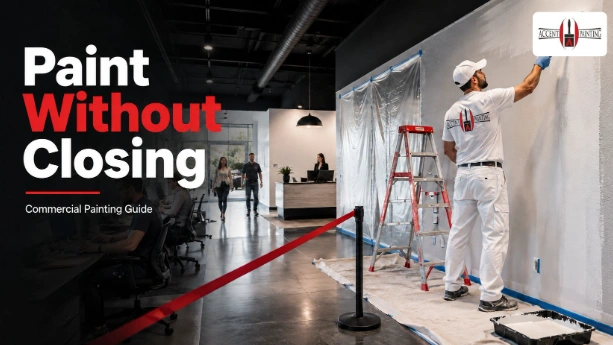
You can repaint an operating business without shutting down by dividing the property into manageable work zones, scheduling disruptive tasks outside customer hours, selecting coatings suited to occupied spaces, and reopening each completed area before moving to the next. The paint itself is rarely the hardest part. Scheduling, access, containment, cleanup, and communication determine whether the business continues running normally.
A good plan may combine after-hours commercial painting, weekend work, and daytime painting in low-traffic areas. The exact approach depends on your business hours, layout, employees, customer traffic, equipment, ventilation, and the condition of the existing surfaces.
Start With Business Operations, Not Paint Colors
Before choosing colors or finishes, walk through the property with the painting contractor and explain how the business actually functions.
The contractor should know:
- When customers and employees arrive
- Which days and hours are busiest
- Which entrances must remain accessible
- Where deliveries and pickups occur
- Which rooms cannot be taken out of service
- Whether alarms, keys, badges, or security escorts are required
- Which equipment cannot be moved or covered
- Whether employees work early, late, or overnight
- When cleaning crews, maintenance teams, or other contractors are present
- Which dates cannot tolerate delays or disruption
A restaurant may have an empty dining room after closing but an active kitchen before sunrise. A retail store may have quiet mornings but heavy evening traffic. An office may be able to rotate employees between departments while conference rooms are painted separately.
That information should become a written commercial painting project plan, not an informal conversation. Contractors experienced with occupied properties commonly map the project section by section and coordinate work around the client’s operating calendar.
In short: The painting schedule should follow the business schedule. The business should not have to reorganize itself around an avoidable painting disruption.
How to Repaint an Operating Business Without Shutting Down: Four Scheduling Options
Most occupied commercial projects use one or more of the following scheduling methods.
Scheduling option | Works well for | Main advantage | Main limitation |
After-hours commercial painting | Retail stores, offices, restaurants, lobbies and customer-facing areas | Keeps the most visible work away from customers | Requires reliable access, security coordination and morning cleanup |
Weekend commercial painting | Offices, professional buildings and businesses with predictable closed days | Provides a longer uninterrupted working window | Large projects may require several weekends |
Phased commercial painting | Warehouses, offices, apartment properties and multi-room facilities | Keeps most of the property available | May increase the total number of calendar days |
Hybrid scheduling | Businesses with mixed operating patterns | Matches each area with the least disruptive time | Requires detailed planning and coordination |
A hybrid plan is often the most practical choice. Customer-facing walls might be painted overnight, private offices may be completed during working hours, and larger repairs might be reserved for weekends.
Phased and off-hours scheduling are commonly used to keep occupied properties functioning while one section is prepared, painted, cleaned, and returned to service.
When after-hours painting makes sense
A night painting crew works well when the contractor can complete the planned work, clean the area, remove hazards, and allow the coating enough time to set before employees return.
It is especially useful for:
- Reception areas
- Retail sales floors
- Main corridors
- Dining areas
- Conference rooms
- Public restrooms
- Customer service counters
When daytime painting may be reasonable
Some work can happen during operating hours when the area is separated from customers and does not interfere with staff.
Possible daytime areas include:
- Storage rooms
- Vacant offices
- Mechanical areas
- Unoccupied apartment units
- Exterior walls away from entrances
- Low-traffic warehouse sections
- Back-of-house corridors
Daytime work should not be forced into a space simply to shorten the timeline. When noise, sanding dust, odor, blocked access, or customer contact cannot be controlled, off-hours work is the better option.
In short: Do not choose a single schedule for the entire property. Match each area with the working window that creates the least operational risk.
Divide the Property Into Finished, Reusable Work Zones
Phased commercial painting means completing the project one defined section at a time rather than opening every room at once.
Each zone should move through the full process:
- Remove or protect furniture and equipment.
- Isolate the work area.
- Repair and prepare the surfaces.
- Apply primer where required.
- Apply the specified finish coats.
- Allow appropriate drying or curing time.
- Inspect the finish.
- Clean the floor, fixtures, and surrounding surfaces.
- Remove barriers when the area is ready.
- Return the completed zone to the business.
Only after that zone is usable should the crew move into the next section.
This prevents the common mistake of having drop cloths, ladders, patching materials, unfinished walls, and displaced furniture spread across the entire property. Occupied-property painting works better when each zone is handed back complete and clean.
Example of a phased office repaint
The following is an example, not a fixed timeline:
- Phase 1: Vacant offices and storage rooms
- Phase 2: Occupied offices, completed department by department
- Phase 3: Conference rooms during unbooked periods
- Phase 4: Hallways during evenings or weekends
- Phase 5: Reception and customer-facing areas after hours
- Phase 6: Final touchups and quality walkthrough
A retail property might instead be divided by sales department, aisle, wall section, stockroom, fitting area, and checkout zone. An apartment community may be divided by building, floor, corridor, stairwell, or unit group.
In short: A zone is not finished when the final coat goes on. It is finished when the business can safely use the area again.
Control Dust, Odor, Noise and Customer Access
The messiest part of a repaint is usually surface preparation, not paint application.
Patching, scraping, sanding, drywall repair, caulking, and removing failed coatings can create more dust and noise than rolling a finish coat. That work should be planned just as carefully as the painting itself.
Useful containment measures may include:
- Plastic barriers around the active zone
- Protected or rerouted walkways
- Floor coverings
- Covered furniture, inventory and equipment
- Vacuum-assisted sanding tools where appropriate
- Closed doors or temporary partitions
- Clearly marked wet-paint areas
- Daily removal of waste and debris
- Cleaning at the end of every shift
Work zones, barriers, signage, ventilation planning, and daily cleanup are recurring parts of occupied-building painting plans because they separate active work from customers and employees.
Use low-odor products carefully
A low-odor commercial paint may reduce complaints and make scheduling easier, but “low VOC” or “zero VOC” should not be treated as a promise that a product has no odor or presents no indoor-air concerns.
The U.S. Environmental Protection Agency notes that VOC labels do not describe every chemical a coating may emit. Product selection should consider the full formulation, the room’s ventilation, the required finish, the application method, and how the space will be used.
Ask the contractor:
- Which coating is being proposed?
- Why is it suitable for that surface?
- Will primer be required?
- What ventilation does the manufacturer recommend?
- How long should the area remain unoccupied?
- Is the product appropriate for high-touch or frequently cleaned surfaces?
- Will spraying, rolling, or brushing be used?
Do not assume every low-VOC product performs the same way. A coating still needs to meet the durability and cleaning requirements of the room.
In short: Product selection and ventilation should be based on the actual room and application method, not on a label alone.
Protect Inventory, Equipment and Finished Surfaces
A functioning business contains far more than empty walls.
Depending on the property, the contractor may need to protect:
- Point-of-sale systems
- Computers and monitors
- Server equipment
- Shelving and inventory
- Kitchen equipment
- Machinery and control panels
- Displays and signage
- Flooring and tile
- Desks and conference tables
- Lighting, switches and outlets
- Security equipment
- Artwork and decorative finishes
Move small items out of the zone whenever practical. Large items that remain should be fully protected before scraping, sanding, priming, or painting begins.
Do not let the crew improvise protection after work has started. The estimate or project plan should state who moves furniture, who disconnects equipment, what the painters will cover, and when each area will be restored.
Sensitive electronics may require instructions from the business’s IT or equipment provider. A painting contractor should not disconnect specialized machinery, security systems, medical devices, or server equipment without authorization from the responsible party.
Set a Daily Handback Standard
A business can technically remain open and still feel as though it is operating inside a construction site. Preventing that requires a clear daily handback standard.
At the end of each shift, the contractor should confirm:
- The agreed work was completed
- Wet or curing surfaces remain protected
- Walkways and exits are open
- Tools and materials are secured
- Floors and nearby surfaces are clean
- Trash and used masking materials are removed
- Furniture is returned when appropriate
- Alarms, doors, lights, and access points are handled correctly
- The next work zone is confirmed
- Any delay or added repair is reported
Daily cleanup and organized work areas are central to reducing employee and tenant complaints in occupied commercial spaces.
For an overnight project, decide who has authority to accept the space each morning. That may be the owner, property manager, facilities manager, store manager, or another assigned representative.
In short: “We finished painting” is not a handback standard. “The area is clean, accessible, inspected and ready for normal use” is.
Communicate With Employees, Tenants and Customers
People tolerate temporary changes better when they know what is happening.
Before the project begins, provide a simple notice explaining:
- The project start date
- The expected completion window
- Which areas will be affected
- When painters will be present
- Whether entrances or walkways will change
- Who employees or tenants should contact
- Whether furniture or personal belongings must be moved
- What to do if someone is sensitive to odor
- How schedule changes will be communicated
Multi-tenant properties need more notice because shared corridors, entrances, parking areas, elevators, and ventilation systems may affect several occupants. Advance schedules and a named point of contact help prevent confusion.
During the project, the business representative and crew leader should have one direct communication channel. Daily updates can include completed areas, current issues, the next zone, photographs, and any decisions required before the next shift.
Avoid routing every question through several employees. One decision-maker reduces conflicting instructions and keeps the commercial painting schedule moving.
Keep the Most Disruptive Work Outside Customer Hours
Not every painting task belongs next to employees or customers.
The following work is usually better scheduled during empty or low-occupancy periods:
- Extensive sanding or scraping
- Spray application
- Strong-smelling primers or specialty coatings
- Work that blocks a primary entrance
- Repairs requiring loud equipment
- Painting around checkout or reception areas
- Work directly above active desks or customer seating
- Coating floors that must remain untouched
- Tasks requiring large ladders, lifts, or barricades
- Work near exposed food, merchandise, or sensitive machinery
Spray-finishing work requires particular attention to containment, ignition sources, ventilation, exhaust, residue, and worker safety. OSHA’s spray-finishing standard includes detailed requirements for controlling vapors, overspray, combustible residue, and ventilation during covered spraying operations.
A professional plan should identify the application method before the project begins. The business should not discover after work starts that a major section needs to be sprayed or closed longer than expected.
Adjust the Plan for Your Type of Business
An occupied commercial space painting plan should reflect what happens inside the building.
Offices
Work department by department. Schedule meeting rooms around bookings and avoid noisy preparation near active workstations.
Retail stores
Keep entrances, checkout areas, fitting rooms, displays, and customer routes clear. Coordinate painting with restocking, deliveries, promotions, and seasonal sales periods.
Restaurants and hospitality properties
Coordinate with food preparation, housekeeping, guest traffic, events, deliveries, and early-morning staff. Painting near active food handling areas may require stricter separation or a different working window.
Warehouses and industrial facilities
Plan around shifts, loading areas, forklifts, production lines, safety routes, machinery, and ventilation. Specialized coatings may also require longer preparation or cure periods.
Apartment and condominium properties
Give residents or tenants advance notice. Keep stairways, corridors, parking access, mail areas, and building entrances available whenever possible.
HOA and community properties
Coordinate the schedule with board representatives, property managers, residents, vendors, landscaping crews, and community events. Exterior work may need to move building by building rather than property-wide.
Las Vegas businesses frequently operate outside a standard Monday-through-Friday office schedule. The contractor should build the plan around the property’s real hours, not assume nights or weekends are automatically empty.
Ask These Questions Before Hiring a Commercial Painter
Not every residential painting crew is prepared to work inside an active commercial property.
Ask prospective contractors:
- Have you completed commercial painting without closing the property?
- Can you create a written, zone-by-zone schedule?
- Who will manage the project each day?
- Can you work evenings, overnight, weekends, or around shift changes?
- How will you contain dust, paint, tools, and debris?
- How will floors, furniture, inventory, machinery, and electronics be protected?
- Which products and application methods do you recommend?
- What ventilation or vacancy period will be required?
- How will work areas be cleaned and reopened each day?
- What happens if hidden drywall damage or failed coatings are discovered?
- Can you provide current licensing and insurance information?
- How will schedule changes be reported?
- Who performs the final walkthrough?
- Can you show examples of similar commercial work?
Accent Painting’s commercial services include work for offices, storefronts, warehouses, apartment properties, and other commercial or industrial spaces. Its published process also emphasizes flexible scheduling, organized execution, communication, surface preparation, site cleanliness, and a final quality walkthrough.
Frequently Asked Questions
Yes. We help homeowners choose colors and finishes that fit their home and can apply a test patch before committing to the full project.
Keep the Doors Open While the Space Gets Refreshed
The practical way to repaint an operating business without shutting down is to treat the project as a coordinated operational plan. Divide the space into controlled zones, schedule each task during the right working window, protect the property, communicate daily, and return each completed section clean and ready for use.
Accent Painting of Las Vegas is a family-owned, third-generation painting company established in 1969. The company provides commercial painting for offices, retail properties, warehouses, industrial spaces, multi-family properties, and other facilities throughout Las Vegas and Southern Nevada, with flexible scheduling and free estimates available.
Call Accent Painting of Las Vegas or request a free estimate to discuss your business hours, property layout, painting needs, and a project schedule designed to minimize disruption.