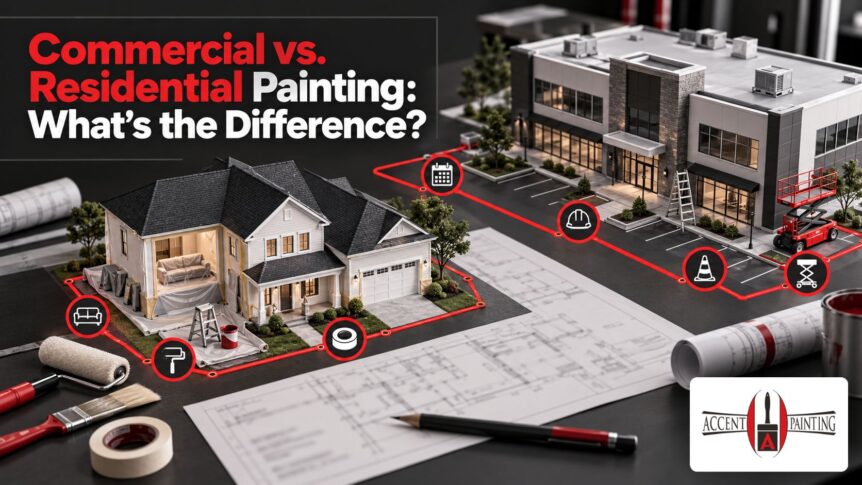
The main difference between commercial vs residential painting is how the project must be planned and executed. Residential painting centers on a homeowner’s living space, appearance, personal preferences, and property protection. Commercial painting must also account for business operations, larger crews, specialized equipment, multiple decision-makers, safety requirements, and coatings selected for heavier use.
Building size is only one factor. A detailed custom home may require more delicate workmanship than a small office, while a modest retail repaint may need complicated scheduling because the business must remain open.
Commercial vs residential painting at a glance
The following comparison shows the practical differences property owners should expect.
Project factor | Residential painting | Commercial painting |
Primary goal | Appearance, comfort, and home protection | Appearance, durability, operations, and property requirements |
Typical properties | Houses, townhomes, and individual condominiums | Offices, stores, hotels, warehouses, government buildings, and managed properties |
Decision-makers | Homeowner or family | Owner, property manager, facilities manager, tenant, board, or general contractor |
Scheduling | Usually completed during normal daytime hours | May require evenings, weekends, phases, or restricted work periods |
Crew size | Usually smaller crews | Crew size may increase to meet scheduling and property demands |
Coatings | Interior and exterior architectural coatings | Architectural, high-durability, industrial, or protective systems |
Equipment | Ladders, sprayers, and standard access equipment | May include lifts, scaffolding, containment, and specialized application equipment |
Site protection | Furniture, flooring, landscaping, and belongings | Inventory, equipment, tenants, customers, vehicles, and business areas |
Communication | Directly with the homeowner | Coordination among several stakeholders |
Project documentation | Estimate, colors, products, and schedule | May include specifications, phasing plans, safety documents, and daily reporting |
In short: Residential painting is shaped around the homeowner and living environment. Commercial painting is shaped around the property’s use, occupants, operational schedule, and performance requirements.
Project purpose and property use
A residential painting contractor typically works in areas where people live. The crew must protect furniture, flooring, landscaping, cabinets, fixtures, and personal belongings while minimizing disruption to the household.
Residential projects may include:
- Interior house painting
- Exterior house painting
- Cabinet refinishing
- Door and trim painting
- Drywall and plaster repair
- Stucco repair and repainting
- Color consultation
A commercial painting contractor works in properties used for business, public services, hospitality, storage, manufacturing, or managed housing. The appearance still matters, but the finish may also need to tolerate frequent cleaning, customer traffic, equipment movement, or exposure to chemicals and weather.
Commercial projects may include:
- Offices and professional buildings
- Retail stores and shopping centers
- Warehouses and industrial facilities
- Hotels and hospitality properties
- Apartment and condominium communities
- HOA common areas and perimeter walls
- Government and municipal facilities
- Restaurants and occupied commercial spaces
The property’s use affects nearly every project decision, from coating selection to when the crew can enter a work area.
Paint products and coating systems
Residential and commercial painters may use some of the same paint brands, but that does not mean they use the same products for every project.
Residential coatings
For a home, product selection commonly depends on room use, desired appearance, washability, sun exposure, and surface material.
A residential system might include:
- Washable wall paint for kitchens or hallways
- Moisture-resistant coatings for bathrooms
- Enamel for doors, trim, or cabinets
- Acrylic exterior paint for stucco or siding
- Compatible primers for bare or repaired surfaces
The homeowner may also place more emphasis on color, sheen, and how the finish looks under natural and artificial light.
Commercial coatings
Commercial paint coatings are often chosen according to traffic, cleaning procedures, substrate, exposure, and facility requirements.
A commercial property may need:
- Scrub-resistant wall coatings
- Low-odor or low-VOC products for occupied spaces
- Urethane coatings for selected surfaces
- Epoxy floor coatings
- Rust-inhibitive primers
- Graffiti-resistant or other protective coatings
- Products specified by an architect or facility manager
“Commercial-grade” is not a complete product specification. The contractor should identify the manufacturer, product line, primer, number of coats, recommended coverage, and the surfaces where each product will be applied.
Industrial painting is a separate category.
Industrial painting may involve steel, equipment, warehouse floors, machinery areas, or surfaces exposed to chemicals and abrasion. These projects can require specialized preparation and coating systems that ordinary architectural paint cannot provide.
A contractor experienced with offices is not automatically qualified to perform complex industrial coating work. The required system, equipment, and safety procedures should be verified before hiring.
In short: Product selection should be based on the surface and its working conditions, not whether the container uses the word “commercial.”
Surface preparation and repairs
Both residential and commercial paint can fail when applied over dirt, chalk, grease, rust, moisture, loose material, or unstable repairs.
Proper painting surface preparation may include:
- Inspecting the existing coating
- Identifying moisture, rust, or adhesion problems
- Cleaning the surface
- Removing loose or peeling paint
- Repairing drywall, plaster, stucco, or damaged wood
- Sanding glossy or uneven areas
- Priming bare and repaired surfaces
- Replacing failed caulk or sealant
- Applying the specified finish coats
The scale and type of preparation may differ. A homeowner might need drywall holes repaired before repainting a bedroom. A warehouse may require degreasing, rust removal, mechanical preparation, or a specialty primer before coating metal.
Preparation should be listed clearly in the estimate. Phrases such as “prep as needed” leave too much room for disagreement.
Crews, equipment, and safety planning
Residential projects usually use smaller crews and conventional access equipment. Commercial properties may require larger teams, lifts, scaffolding, controlled work zones, or coordination with other contractors.
Commercial safety planning can involve:
- Fall protection
- Lift operation
- Pedestrian and vehicle control
- Restricted-area access
- Ventilation
- Product safety data
- Protection around customers or tenants
- Coordination with facility personnel
- Daily cleanup and equipment storage
The required planning depends on the building. A single-story office does not have the same risks as a warehouse ceiling, hotel exterior, or multi-story apartment complex.
Home painting also requires careful safety and protection. The difference is usually the number of occupants, type of equipment, building access, and complexity of the work environment.
Scheduling and minimizing disruption
Residential painting is generally scheduled around the homeowner’s routine. The contractor may complete one room or section at a time so the house remains usable.
Occupied commercial painting requires a different level of coordination. Painting during normal business hours may interfere with customers, employees, tenants, deliveries, or equipment.
Commercial scheduling options may include:
- Evening or weekend work
- Floor-by-floor completion
- Work divided into tenant areas
- Painting during planned closures
- Completing public areas during low-traffic periods
- Daily removal or secure storage of equipment
- Low-odor products for occupied spaces
A phased schedule may take longer than unrestricted work, but it can reduce interference with business operations.
Before the project begins, the owner and contractor should agree on access hours, work zones, drying times, noise restrictions, cleanup expectations, and who will approve completed phases.
In short: The right schedule is not always the fastest schedule. It is the one that allows the coating to be applied correctly without creating avoidable problems for occupants or operations.
Where multi-family and HOA painting fit
Apartments, condominiums, and HOA communities contain residential spaces, but the painting project is usually managed like commercial work.
Multi-family painting and HOA painting services may involve:
- Multiple buildings or units
- Residents remaining on-site
- Board or management approval
- Community color standards
- Notices to residents
- Parking and access coordination
- Phased schedules
- Common-area protection
- Consistent finishes across several structures
Painting a single condominium interior may be a residential project. Repainting the exterior of an entire condominium community is usually a commercial-scale project because of its management, access, scheduling, and communication requirements.
Property managers should look for contractors who can manage both the physical work and resident coordination.
How estimates and project management differ
A residential estimate may focus on rooms, walls, trim, repairs, colors, and furniture protection. Communication is normally direct between the homeowner and contractor.
A commercial building painting proposal may need more detail because several people may review it. A useful commercial proposal should identify:
- Included buildings, rooms, and surfaces
- Excluded surfaces
- Preparation and repair work
- Primer and finish products
- Number of coats
- Access equipment
- Work hours and project phases
- Protection and containment
- Cleanup responsibilities
- Change-order procedures
- Project supervision
- Final inspection process
The lowest proposal is not necessarily the least expensive project. A lower price may exclude repairs, access equipment, additional coats, after-hours work, or surfaces included by another bidder.
Compare scope before comparing the final number.
How to choose the right painting contractor
The label “commercial painter” or “residential painter” is not enough. Look at whether the contractor has relevant experience with your property, surface materials, access conditions, and required coating system.
Ask these questions:
- Have you completed projects with this property type?
- Who will supervise the work?
- What preparation is included?
- Which primer and finish products will be used?
- How many coats are included?
- How will occupants, furniture, inventory, or landscaping be protected?
- Can you work around our operating or household schedule?
- Is access equipment included in the proposal?
- How will additional repairs or scope changes be approved?
- Are you licensed and properly insured for this project?
- What will be reviewed during the final walkthrough?
For Nevada projects, property owners should verify contractor licensing through the appropriate state authority rather than relying only on a website or advertisement.
Can a residential painter handle a commercial project?
Sometimes. A residential company may be capable of painting a small office or retail suite if it has the appropriate license, insurance, equipment, staff, and relevant experience.
The reverse is also true. A commercial contractor may paint homes, but homeowners should confirm that the crew is prepared for detailed protection, occupied-room work, trim finishing, and direct communication.
Choose based on demonstrated capability, not the category printed on the company vehicle.
Frequently asked questions
Residential painting focuses on homes, personal preferences, and protecting living spaces. Commercial painting also accounts for business operations, multiple stakeholders, specialized coatings, equipment, safety, and scheduling.
It can be, especially when the property is occupied, multiple buildings are involved, or specialty access and coatings are required. A detailed residential project can still demand significant preparation and craftsmanship.
The product depends on the surface and building use. Commercial projects may use washable acrylic coatings, low-odor products, urethanes, epoxies, rust-control primers, or other protective systems.
Many commercial contractors offer phased, evening, or weekend scheduling when the property must remain operational. Availability and additional scheduling requirements should be confirmed in the proposal.
Painting one apartment for an individual may be residential. Painting multiple units, common areas, or an entire apartment complex is normally managed as a commercial or multi-family project.
Yes. Both estimates should state what cleaning, sanding, repairs, priming, caulking, and surface protection are included. Vague preparation language can lead to inconsistent expectations.
Compare the surfaces, preparation, repairs, products, coats, equipment, scheduling, cleanup, and exclusions. Comparing total price without comparing scope can produce a misleading result.
Choosing between commercial vs residential painting services
The right choice between commercial vs residential painting depends on the property’s use, required coatings, occupants, schedule, access, and project-management needs. A small business may still need commercial painting, while a large home may require detailed residential craftsmanship.
Accent Painting of Las Vegas has handled residential and commercial painting projects since 1969. The licensed, insured, and bonded team serves homeowners, businesses, property managers, HOAs, and multi-family communities across Las Vegas, Henderson, and the Las Vegas Valley.
For help defining the correct scope for your property, contact Accent Painting of Las Vegas to schedule a painting assessment and request a free quote.