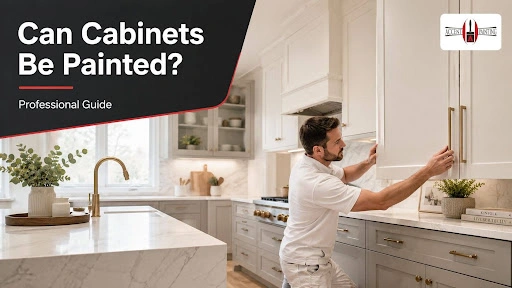
Yes, your cabinets can be professionally painted, is a question with a positive answer in most cases. Solid wood, MDF, plywood, veneer, laminate, melamine, metal, and some thermofoil cabinets can all be painted when the surface is sound, and the preparation system matches the material.
That does not mean every cabinet should be painted. Cabinets with widespread water damage, swollen cores, severe warping, failing surface coverings, or weak construction may need repairs, refacing, partial replacement, or complete replacement instead.
The smartest first step is not choosing a color. It is identifying what the cabinets are made from and whether they provide a stable foundation for a new finish.
Can Your Cabinets Be Professionally Painted Regardless of Material?
Most common cabinet surfaces are suitable for professional cabinet painting, but they do not all receive the same treatment.
Wood and MDF generally accept coatings well. Laminate and melamine require careful abrasion and an adhesion-promoting primer, while thermofoil must be inspected for lifting, bubbling, or heat damage before painting begins. Consumer guidance also recognizes wood, wood veneer, metal, and laminate as paintable surfaces when the correct products and preparation are used.
A professional assessment should answer three separate questions:
- Will a coating adhere to this surface?
- Is the material underneath the surface still stable?
- Is painting financially sensible compared with repairs or replacement?
A cabinet can technically accept paint and still be a poor investment. Painting over a loose surface layer or swollen substrate only covers the problem temporarily.
In short: Most cabinets can be painted, but condition determines whether they should be painted.
How to Identify Your Cabinet Material
Many kitchens contain more than one material. The doors may be solid wood or MDF, while the cabinet boxes could be plywood, particleboard, laminate-covered board, or melamine.
Look in these areas before making assumptions:
- Inside a hinge opening
- Along the top or bottom edge of a door
- Behind a drawer front
- Around chipped or damaged areas
- Inside unfinished cabinet boxes
Natural grain that continues through the edge usually indicates solid wood. A thin real-wood layer over another material is likely veneer.
MDF has a smooth, dense, fiber-like interior. Particleboard has larger visible wood particles, while laminate, melamine, and thermofoil appear as thin decorative layers attached to an engineered core.
Do not rely on appearance alone. A realistic wood-grain laminate can resemble natural wood until the edge or substrate is inspected.
Expert tip: Ask the painter to identify both the visible surface and the underlying core. The coating must bond to the surface, but the long-term result also depends on the condition of the core.
Cabinet Painting Suitability by Material
Cabinet material | Can it be painted? | Main preparation requirement | When painting may not be wise |
Solid wood | Yes | Degreasing, sanding, repairs, suitable primer | Severe warping, rot, or unstable old coatings |
MDF | Yes | Seal exposed edges and damaged areas | Swelling, crumbling edges, or moisture damage |
Plywood | Yes | Sanding, edge repair, compatible primer | Delaminated layers or extensive water damage |
Wood veneer | Usually | Gentle sanding and adhesion testing | Loose, chipped, or heavily sanded-through veneer |
Laminate | Usually | Light abrasion and bonding primer | Peeling laminate or damaged substrate |
Melamine | Usually | Degreasing, controlled abrasion, bonding primer | Weak particleboard or widespread edge damage |
Thermofoil | Sometimes | Inspect wrap, repair or remove failed film | Bubbling, lifting, shrinking, or heat damage |
Metal | Yes | Rust removal and metal-compatible primer | Extensive corrosion or structural damage |
Previously painted cabinets | Usually | Adhesion testing and removal of failing layers | Thick, peeling, incompatible, or unstable coatings |
Solid Wood Cabinets
Solid wood is one of the most dependable materials for kitchen cabinet painting. Oak, maple, cherry, birch, pine, and other species can accept durable finishes when grease, polish, old coatings, and surface defects are properly addressed.
The main visual issue is grain. Open-grained woods such as oak may retain visible texture after painting unless the grain is filled.
That is not automatically a defect. Some homeowners prefer to see subtle grain because it preserves the character of the wood, while others want a flatter, furniture-like appearance.
Solid wood also expands and contracts slightly as environmental conditions change. The primer and finish system must be suitable for cabinet use rather than ordinary wall paint.
Painting may not be worthwhile when doors are badly warped, joints are separating, or previous coatings are peeling through several layers.
In short: Paint wood cabinets when they are structurally sound, and you are comfortable either retaining the grain or paying for the extra preparation needed to reduce it.
MDF Cabinets
MDF, or medium-density fiberboard, is made from compressed wood fibers and resin. Its flat, consistent surface makes it a common material for painted cabinet doors.
Properly prepared MDF can produce a very smooth finish. Its weakness is moisture exposure, especially around raw edges, hinge holes, sink cabinets, damaged corners, and areas where the original coating has failed.
A professional preparing to paint MDF cabinets should:
- Inspect for swollen or fuzzy areas
- Seal exposed edges
- Repair chips and dents
- Use a primer compatible with MDF
- Avoid saturating damaged areas
- Sand between coats when required
Minor edge damage can often be repaired. Widespread swelling cannot simply be sanded flat because the material underneath has already changed shape.
In short: MDF paints well when dry and stable, but swollen MDF should be repaired or replaced before refinishing.
Plywood Cabinets
Plywood is built from thin wood layers bonded together. It is commonly found in cabinet boxes and sometimes in doors, shelves, or drawer components.
Sound plywood can be painted using methods similar to wood. Exposed edges may need filling if the homeowner wants a smooth appearance rather than visible layered lines.
The warning sign is delamination. When moisture causes the layers to separate, paint cannot restore the lost structural bond.
Small damaged sections may be repairable. Cabinets with extensive separation, soft areas, or distorted panels need more than a cosmetic coating.
Wood Veneer Cabinets
Wood veneer is a thin layer of real wood applied over MDF, plywood, or another stable core. It can often be painted successfully, but sanding must be controlled because the wood layer is thin.
Aggressive sanding can cut through the veneer and expose the material beneath it. Loose edges, bubbles, missing sections, and delamination should be repaired before applying primer.
Homeowners should also consider whether painting is the desired aesthetic choice. A well-preserved wood veneer may be better suited to staining or clear finishing when the goal is to retain natural grain.
Choose paint veneer cabinets when the veneer is securely bonded, and a solid-color finish is preferred. Choose staining or clear finishing when preserving the natural appearance matters more.
Laminate Cabinets
Laminate is a smooth, nonporous surface attached to MDF or particleboard. Its resistance to moisture and staining also makes it resistant to ordinary paint adhesion.
That does not make it unpaintable. Successful paint laminate cabinets projects depend on thorough cleaning, light abrasion, and a bonding primer designed for slick surfaces.
The sanding must be controlled. Excessive abrasion can cut through the thin laminate layer and expose the core underneath. Lowe’s similarly advises using a special bonding primer on laminate and avoiding deep sanding that damages the surface.
Laminate should be firmly attached before painting. Loose corners, peeling sheets, exposed particleboard, or water-damaged edges must be repaired first.
In short: Laminate can be professionally painted, but skipping the adhesion primer is an invitation for peeling.
Melamine Cabinets
Melamine is a resin-treated decorative layer commonly bonded to MDF or particleboard. It is often found on cabinet interiors, flat-panel doors, shelving, and budget cabinet systems.
Like laminate, melamine is smooth and nonporous. It needs degreasing, controlled sanding, and a primer made to bond to difficult surfaces.
The surface may be paintable even when the cabinet underneath is not worth saving. Older melamine cabinets frequently use particleboard cores that can weaken around hinges, sink areas, and exposed edges.
Before painting, check whether:
- Hinges still hold securely
- Door edges are intact
- The core is swollen
- Surface layers are separating
- Shelves or cabinet boxes are sagging
Painting can improve the appearance, but it cannot strengthen deteriorating particleboard.
Thermofoil Cabinets
Thermofoil is a thin vinyl covering formed around an MDF door or drawer front. The suitability of painting thermofoil cabinets depends heavily on whether that vinyl remains firmly attached.
Sound thermofoil may accept a compatible adhesion primer after cleaning and careful surface preparation. The problem is that thermofoil often begins lifting near ovens, ranges, dishwashers, and other heat-producing areas.
Minor edge lifting may sometimes be repairable. When the wrap is bubbling, shrinking, peeling across multiple doors, or separating from the MDF, painting directly over it is risky.
In some cases, the loose thermofoil can be removed and the MDF underneath prepared for painting. In other cases, replacing affected doors while refinishing the remaining cabinets is more practical.
In short: Thermofoil is not an automatic “yes.” The vinyl layer must be stable, or it must be removed before the MDF is painted.
Metal Cabinets
Older kitchens, workshops, utility rooms, offices, and commercial properties may have steel or other metal cabinetry. Metal can be painted, but the coating system differs from what would be used on wood.
Preparation may include:
- Degreasing
- Removing loose paint
- Treating rust
- Sanding or scuffing
- Applying a corrosion-resistant metal primer
- Using a compatible finish coating
Metal cabinets with surface rust may still be repairable. Cabinets with perforation, deep corrosion, broken welds, or structural distortion may need fabrication work or replacement.
Previously Painted Cabinets
Previously painted cabinets are often suitable for repainting when the existing coating is firmly bonded.
A painter should test adhesion rather than assume the old finish is stable. New paint applied over a failing layer will fail with it, regardless of the quality of the new coating.
Warning signs include:
- Peeling around handles
- Soft or gummy paint
- Thick brush marks
- Cracking at panel joints
- Several heavy layers obscuring details
- Unknown coatings that react with cleaners or primers
A light, stable coating may only need cleaning, sanding, and priming. Thick or poorly bonded paint may require stripping or more extensive removal.
When Cabinets Should Not Be Painted
Cabinet painting is a surface improvement, not structural reconstruction. Replacement or selective repairs may be the more honest recommendation when the foundation is no longer sound.
Painting may not be sensible when you find:
- Widespread water damage
- Swollen MDF or particleboard
- Soft cabinet floors under sinks
- Severe door warping
- Loose or separating veneer
- Widespread thermofoil failure
- Broken cabinet boxes
- Unrepairable hinge damage
- Layout problems painting cannot solve
- Doors or drawers that no longer fit properly
Minor dents, scratches, worn coatings, dated colors, and isolated edge damage are usually preparation issues. Structural movement and material failure are different.
Do not let a contractor treat every defect as something primer will fix. Primer improves coating adhesion; it does not reverse water damage, rebuild crumbling board, or flatten a warped door.
In short: Paint cabinets that are unattractive but sound. Repair, reface, or replace cabinets that are physically failing.
How Professionals Paint Kitchen Cabinets
A reliable cabinet surface preparation process is more involved than brushing paint onto doors while they remain attached.
The exact sequence varies by material, but professional work commonly includes:
- Inspecting the cabinet material and condition
- Discussing finish expectations
- Protecting floors, counters, walls, appliances, and nearby rooms
- Removing and labeling doors, drawers, hinges, and hardware
- Degreasing every paintable surface
- Repairing chips, dents, cracks, and open seams
- Sanding or abrading the surface appropriately
- Removing dust and residue
- Applying the correct primer
- Sanding between coats when required
- Applying the finish coats
- Allowing suitable drying and curing time
- Reinstalling components in their original positions
- Completing a final inspection
Cleaning, sanding, repairing, and priming create the foundation for adhesion. Professional spraying can also produce a more uniform appearance on doors and drawer fronts than an inexperienced brush-and-roller application.
The word “dry” should not be confused with “cured.” A finish may feel dry before it has developed enough hardness for normal cleaning, hardware pressure, or daily impact.
Follow the coating manufacturer’s curing instructions and avoid aggressive cleaning immediately after the project.
Painting Versus Refinishing, Refacing, or Replacing
These terms are often used as though they mean the same thing, but they describe different scopes of work.
Cabinet painting
The existing surfaces receive an opaque painted finish. Wood grain may remain slightly visible depending on the material and preparation.
Cabinet refinishing
Cabinet refinishing is a broader term that can include painting, staining, stripping, clear coating, glazing, or applying another finish to existing cabinet components.
Cabinet refacing
The cabinet boxes remain, but the doors and drawer fronts are replaced. Visible box surfaces may receive matching veneer, laminate, or paint.
Refacing can make sense when the boxes are solid, but the doors are damaged, dated, or unsuitable for painting.
Cabinet replacement
The old cabinet system is removed, and new boxes, doors, drawers, and related components are installed.
Replacement may be justified when the layout does not work, storage is insufficient, the boxes are damaged, or too many components require repair.
Option | Appropriate when | Main limitation |
Painting | Cabinets are sound, and the color or finish is outdated | Does not change the door style or kitchen layout |
Refinishing | Existing wood or coatings can be restored or changed | Depends on the condition of the original material |
Refacing | Boxes are sound, but doors or fronts need replacement | Existing layout and box structure remain |
Replacement | Layout, structure, storage, or cabinet condition is poor | More demolition, disruption, and project scope |
In short: Do not replace sound cabinets merely because the color is dated. Do not paint failing cabinets merely because painting appears simpler.
Cabinet Painting Considerations for Las Vegas Homes
For homeowners researching cabinet painting in Las Vegas, the material and condition remain more important than the outdoor desert climate. However, local dust, active ventilation systems, and the need to protect occupied interiors can affect how the work area is controlled.
A proper setup should reduce airborne dust, protect nearby surfaces, and provide suitable ventilation without allowing debris to settle into fresh coatings.
Accent Painting of Las Vegas offers cabinet painting, staining, protective top coats, custom finishes, refacing, and hardware replacement as part of its cabinet refinishing services. The company also states that it has served the Las Vegas area since 1969 and uses a preparation-focused process with professional painting products.
An on-site inspection is particularly useful when the kitchen has mixed materials, previous DIY paint, damaged sink cabinets, failing thermofoil, or doors that may need selective replacement.
Frequently Asked Questions
Final Thoughts: Can Your Cabinets Be Professionally Painted?
For most homeowners, the answer to can your cabinets be professionally painted is yes. Wood, MDF, plywood, veneer, laminate, melamine, metal, and selected thermofoil surfaces can be updated when they are structurally sound and prepared with the correct products.
The bigger question is whether painting is the right investment for the condition of your cabinets. A proper inspection should identify the material, check for moisture or adhesion problems, explain the necessary repairs, and compare painting with refacing or replacement where appropriate.
Accent Painting of Las Vegas provides professional cabinet painting and refinishing for kitchens, bathrooms, built-ins, and other cabinetry throughout Las Vegas, Henderson, and surrounding Southern Nevada communities. Call now or request a free estimate to have your cabinets evaluated before deciding whether to paint, repair, reface, or replace them.