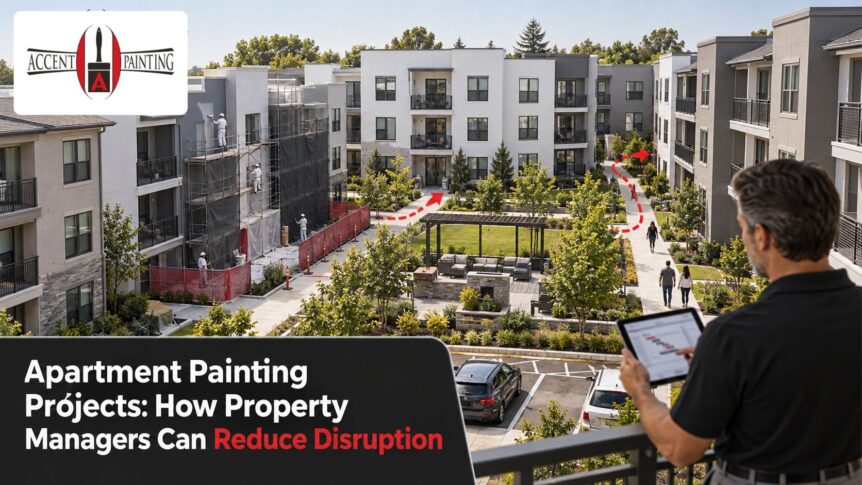
Property managers can reduce disruption during apartment painting projects by defining the scope before mobilization, dividing the property into manageable phases, notifying residents clearly, confirming access and parking requirements, and requiring daily cleanup and inspections. Most complaints do not come from the act of painting itself. They come from residents not knowing what will happen, when areas will be inaccessible, or what they need to do beforehand.
A reliable plan should cover residents, maintenance staff, painters, vendors, vehicles, landscaping, common areas, and emergency access. That coordination becomes especially important when work involves multiple buildings or occupied units.
Define the project before setting the schedule.
A contractor cannot produce a dependable schedule from a vague request such as “paint the apartment complex.” The property manager should first identify exactly what is included.
The scope may cover:
- Occupied apartment interiors
- Vacant-unit or apartment turnover painting
- Building exteriors
- Stairwells and breezeways
- Leasing offices
- Clubhouses and fitness rooms
- Laundry rooms
- Hallways and lobbies
- Carports and garages
- Railings, doors, and trim
- Perimeter walls
- Stucco or drywall repairs
Each area creates different access, preparation, product, and drying-time requirements. Painting a vacant unit between residents is simpler than coating an occupied hallway that must remain available throughout the day.
The initial inspection should also document peeling paint, damaged stucco, drywall repairs, rust, failed caulk, water staining, and surfaces that may require specialty primers.
A written scope should explain:
- Which buildings and surfaces are included
- Which repairs are included
- Which surfaces are excluded
- The specified primers and finish products
- The expected number of coats
- Who moves furniture or property
- Who handles resident notices
- How additional repairs will be approved
In short: A realistic schedule starts with a specific scope. If the work is poorly defined, the schedule and resident notices will also be unreliable.
Use a phased apartment painting schedule.
Trying to open too many work areas at once creates confusion. Residents encounter blocked walkways, staff loses track of completed areas, and painters must move equipment repeatedly.
A phased apartment painting schedule divides the property into zones, buildings, floors, or groups of units. One area is completed and inspected before the next area becomes active.
A practical sequence might be:
- Pressure washing or initial cleaning
- Repairs and preparation
- Priming
- First finish coat
- Final coat and detail work
- Inspection and corrections
- Reopening the area
- Moving to the next phase
The manager and contractor should create a map identifying active, upcoming, and completed work zones. A visual phase map is easier for leasing staff, maintenance teams, and residents to understand than a long list of unit numbers.
Include schedule buffers
Paint schedules can change because of weather, unexpected repairs, access problems, material delays, or surfaces needing additional drying time.
A buffer between phases prevents one delay from immediately making every resident notice inaccurate. It also gives the contractor time to complete punch-list work before opening another section.
For exterior apartment painting in Las Vegas, the schedule should account for direct sunlight, wind, dust, and surface temperatures. Painters may need to work on shaded elevations and move around the property as exposure changes.
Build a clear resident communication plan.
A useful resident communication plan answers five questions:
- What work is being completed?
- Where will painters be working?
- When will the work begin and end?
- What must residents do?
- Who should residents contact with a problem?
Residents should receive an initial project announcement followed by a phase-specific reminder. The notice period should comply with lease terms, property policies, applicable laws, and any legal guidance used by management.
Avoid sending the same generic notice to the entire property. A resident whose building will not be painted for several weeks does not need the same instructions as someone whose entry door is being painted tomorrow.
Resident notices should include practical instructions.
Depending on the project, the notice may ask residents to:
- Remove personal items from balconies or patios
- Move furniture away from selected walls
- Keep pets secured
- Remove decorations from doors
- Close windows during exterior spraying
- Relocate vehicles from identified spaces
- Avoid marked walkways or stairwells
- Confirm access arrangements
- Report scheduling conflicts through a named contact
Notices should state whether doors, windows, balconies, parking spaces, laundry rooms, or common areas will be temporarily unavailable.
If the community serves residents who use different languages, translated notices may reduce confusion. Management should also provide a clear way for residents to raise accessibility or accommodation concerns.
In short: “Painting starts Monday” is not an adequate notice. Residents need location-specific instructions and a reliable contact person.
Control access, parking, pets, and personal belongings
Access problems can stop an otherwise well-planned phase. Before painters arrive, management should confirm keys, gate codes, vacant-unit status, restricted areas, and staff contacts.
For occupied apartment painting, residents should know whether they must be present and who is authorized to enter. Contractors should not be expected to resolve access disputes at the door.
Parking and vehicle protection
Exterior painting may require lifts, ladders, material staging, or temporary closures around buildings. Spraying also creates an overspray risk if vehicles remain too close to the work zone.
Parking notices should identify:
- The exact spaces or rows affected
- The closure date and time
- Alternative parking locations
- When spaces will reopen
- Who to contact if a vehicle cannot be moved
Physical signs should match the written notice. Conflicting dates are a fast way to generate complaints.
Pets and occupied units
Residents should secure pets before painters enter a unit or work near patios and entryways. The painting contractor should not be responsible for handling or relocating animals.
Management should establish a process for missed access. One inaccessible unit should not force the crew to improvise or disrupt the entire phase.
Match products and application methods to the property
Product selection affects odor, drying time, durability, cleaning, and how quickly an area can return to service.
For common area painting, managers may need coatings that tolerate regular cleaning and frequent contact. Exterior stucco, metal railings, doors, wood trim, and concrete surfaces require different primers and finishes.
A coating plan should identify:
- Product name and manufacturer
- Approved surfaces
- Primer requirements
- Finish and sheen
- Recoat time
- Ventilation requirements
- Required surface preparation
- Cleaning and maintenance guidance
Low-odor products still require planning
Low-odor paint for apartments may be useful in occupied spaces, but low odor does not mean odor-free or suitable for every resident. Ventilation and product instructions still matter.
Management should avoid promising that residents will notice no odor. A more accurate approach is to explain which products are being used, how ventilation will be managed, and when an area can be occupied normally.
Spraying versus rolling
Spraying can cover large exterior surfaces efficiently, but it requires careful masking, wind monitoring, and control of vehicles and pedestrians. Rolling or brushing may be more appropriate in occupied areas or near surfaces that are difficult to protect.
The fastest application method is not automatically the least disruptive. Setup, containment, and cleanup must also be considered.
Coordinate the contractor, staff, and vendors.
Successful painting project management requires one decision-maker from management and one project lead from the contractor. Instructions coming from several employees can create conflicting priorities.
Before work starts, agree on:
- Daily start and stop times
- Approved work zones
- Resident-notice responsibilities
- Key and access procedures
- Material storage
- Water and electricity access
- Waste disposal
- Landscaping coordination
- Emergency contact procedures
- Daily progress updates
- Change-order approval
- Inspection responsibilities
Maintenance staff should identify active leaks, recurring stucco damage, irrigation problems, and recent repairs before painting begins. Painting over an unresolved moisture problem hides the symptom without correcting the cause.
Other vendors also need to know the schedule. Landscaping crews, delivery companies, pool maintenance teams, and trash collection may interfere with lifts, wet coatings, or closed parking areas if they are not informed.
Use a daily closeout process.
At the end of each workday, the contractor should:
- Remove or secure equipment
- Clear required walkways
- Collect debris
- Confirm wet-paint areas are marked
- Report completed and incomplete work
- Identify access problems
- Confirm the next day’s work zone
- Report any damage or unexpected repairs
A five-minute daily review can prevent small issues from becoming property-wide complaints.
Plan for the most common disruption risks
A project plan should address predictable problems before they occur.
Disruption risk | What can happen | Preventive action |
Unclear resident notices | Residents fail to prepare patios, vehicles, or units | Send location-specific notices and reminders |
Too many active work zones | Walkways, parking, and staff become overwhelmed | Complete the property in controlled phases |
Missed unit access | The crew loses production time | Confirm access and create a missed-unit procedure |
Unexpected repairs | The phase falls behind schedule | Inspect surfaces early and include a time buffer |
Wind or extreme heat | Spraying or coating conditions become unsuitable | Monitor weather and surface conditions |
Poor daily cleanup | Residents encounter equipment or debris | Require a documented daily closeout |
Conflicting instructions | Crews repeat or skip work | Assign one management contact and one contractor lead |
Uncontrolled scope changes | Schedule and budget become unreliable | Use written change-order approval |
Incomplete inspections | Defects appear after the crew leaves | Inspect each phase before reopening it |
Not every delay can be avoided. The objective is to prevent one problem from disrupting the rest of the property.
Inspect each phase before releasing it.
Waiting until the end of a large apartment complex painting project to inspect the work is inefficient. Equipment may already be removed, occupied areas may need to be reopened, and small defects may appear across several buildings.
Inspect each phase while the crew and materials are still nearby.
The review should check:
- Specified surfaces were completed
- Repairs are visually acceptable
- Coverage and color are consistent
- Doors and windows operate correctly
- Fixtures and adjacent surfaces are clean
- Masking and protective materials were removed
- Walkways are clear
- Unit or building numbers remain visible
- Touch-ups are completed
- Damage or incomplete work is documented
The manager and contractor should maintain one shared punch list. Separate lists created by leasing, maintenance, ownership, and residents can cause duplicate or contradictory requests.
Resident reports should be logged, reviewed, and assigned rather than passed informally to whoever is on-site.
In short: Finish and inspect one phase before opening several new work areas.
Choose an apartment painting contractor with the right systems
A qualified apartment painting contractor needs more than painting ability. The company must also manage residents, multiple buildings, access restrictions, schedules, equipment, repairs, and communication.
Property managers should ask:
- Have you completed occupied multi-family projects?
- Who will supervise the work daily?
- How will the property be divided into phases?
- What preparation and repairs are included?
- How will residents and vehicles be protected?
- What happens when a unit cannot be accessed?
- How will weather delays be communicated?
- What products and primers will be used?
- How will additional repairs be approved?
- What is included in the daily cleanup?
- How will inspections and corrections be documented?
- Are you properly licensed and insured for the work?
A low proposal may omit repairs, access equipment, additional coats, resident coordination, or after-hours work. Compare the complete scope rather than comparing only the final price.
Frequently asked questions
Start with a property inspection and written scope. Divide the property into phases, create a resident-notice schedule, confirm access procedures, coordinate vendors, and inspect each phase before continuing.
Limit the number of active work zones, provide specific instructions, protect access routes, control parking closures, secure equipment daily, and give residents one reliable contact.
The correct notice period depends on lease terms, property policies, applicable laws, and whether unit entry is required. Management should verify those requirements and send reminders close to the scheduled work.
Yes, when access, furniture protection, pets, ventilation, drying time, and resident communication are managed properly. Vacant units are generally easier to schedule and complete.
Often, but not always. Building-by-building phasing works well for many properties, while floor-by-floor or zone-based scheduling may be better for interior common areas or connected buildings.
The contractor should notify the property manager, update the active phase, and issue revised resident or parking notices when necessary. A schedule buffer reduces the effect on later phases.
If work disturbs painted surfaces in qualifying pre-1978 housing, federal lead-safe renovation requirements may apply. Property managers should verify building age and use contractors who understand the applicable rules.
Reducing disruption during apartment painting projects
Well-managed apartment painting projects depend on a defined scope, controlled phasing, clear resident instructions, reliable access, daily cleanup, and phase-by-phase inspections. Painting skill matters, but weak communication and scheduling can still turn competent work into a frustrating experience for residents and staff.
Accent Painting of Las Vegas has served Southern Nevada since 1969. Its licensed, insured, and bonded team handles multi-family, apartment complex, condominium, HOA, exterior, and interior painting across Las Vegas, Henderson, and the Las Vegas Valley.
If your property needs painting without unnecessary disruption to residents or daily operations, contact Accent Painting of Las Vegas to schedule an assessment and request a free quote.